

Tuesday, March 5, 2013
Blue Eyed Hermit Crab

Tuesday, February 19, 2013
Round-Rib and Zigzag Scallops
 I am putting both the round-rib and the zigzag scallops in the same post because they both look similar. The round-rib scallop (Euvola raveneli) is in the left of the photos and it has no zigzag going through the shell like the zigzag scallop (Euvola ziczac) which is on the right of the pictures. They are hard to find and I have only found one of each. The flat shell is the upper shell and the lower shell is round, not flat.
Tuesday, February 12, 2013
Spiny Jewel Box Shells
 |
| Spiny jewel box shells. |
 |
| Fossilised spiny jewel box shell. |
 |
| Big and small spiny jewel box shells. |
 |
| Spiny jewel box shell connected. |
Tuesday, February 5, 2013
Kitten Paws
 |
| A variety of kitten paws. |
 |
| A small kitten paw And a big kitten paw. |
 |
| A kitten paw with both shells attached. |
Wednesday, January 30, 2013
Fossils
Fossils are rare on some beaches, but I thought that I should show you how to identify them if you do find some.
 |
| This is a piece of a turtle shell, I think that it is a piece of soft shelled turtle shell because it is not completely hard. |
 |
| These are puffer fish teeth. They are layered unlike most other teeth you might find on the beach. |
 |
| These are some of my favorite fossils, stingray barbs. The one on top is not completely fossilized and is more fragile than the fully fossilized one. |
 |
| These are horse teeth. They are bigger than the other fossils that I have already posted about. |
 |
| These are stingray mouth plates. They are very common on some beaches. |
Tuesday, January 22, 2013
Red Tide
Recently, Florida's west coast has been experiencing red tide. Yesterday I went to Lido with my mom and we walked all the way down to a wall that we walk down to. At the wall, there was lots of dead fish on the sand. It smelled bad and red tide makes it hard to breath. The red tide didn't seem to be effecting the seabirds too much, but we were only seeing the birds that were close to shore and not the ones farther out. There were also lots of olive snails stranded near the water. We put all that we could find back in the water. We did not find many good shells that day, or much trash.
Tuesday, January 1, 2013
Coquinas
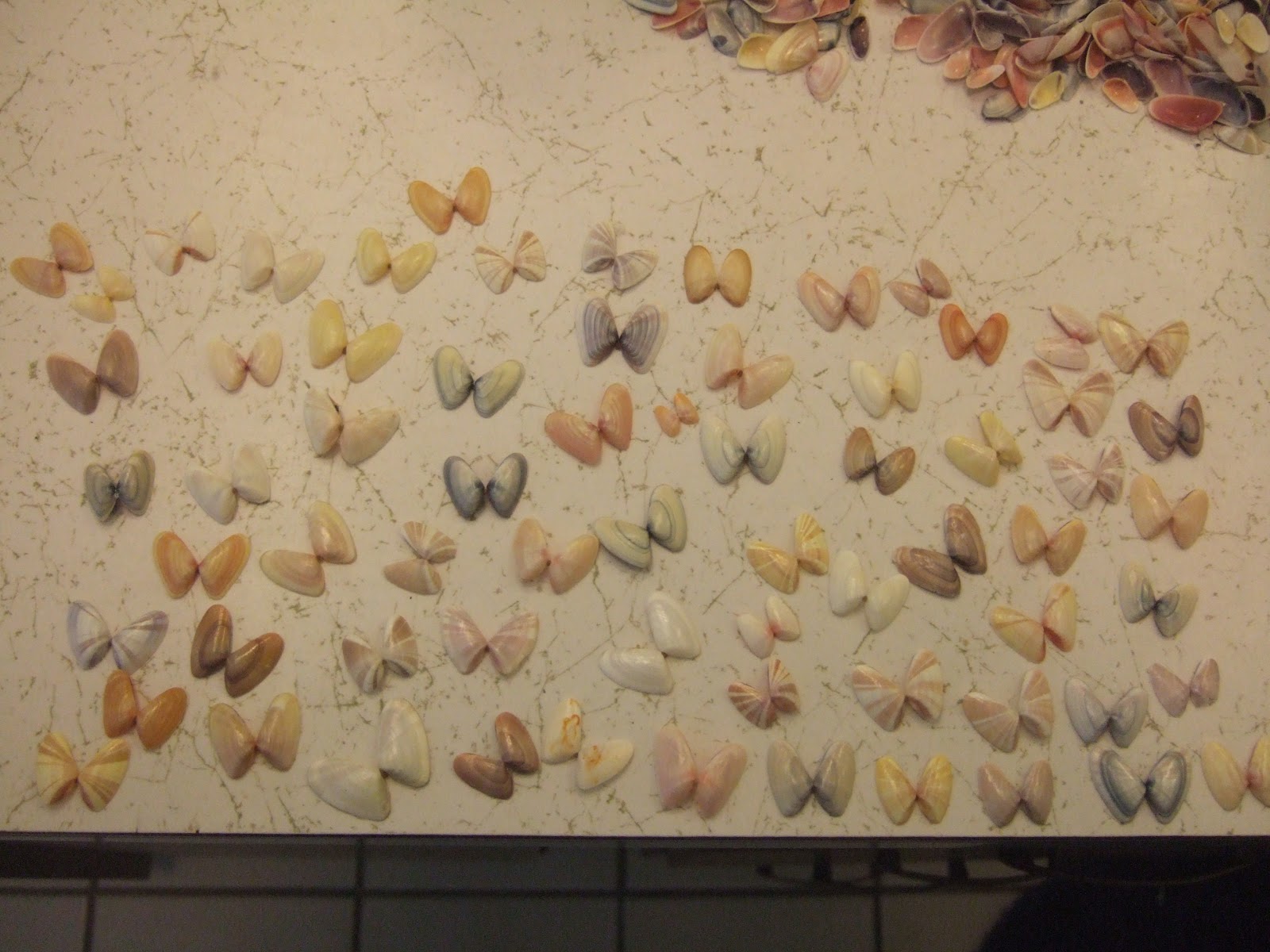

 These are Donax variabilis, or coquinas. They are bivalves, like scallops, and oysters. They come in many colors like purple, yellow, brown, pink, and lots more. They are very common in Florida. The top photo is of connected coquinas. The second photo is of disconnected coquinas. The third is of a coquina I found in my jar of coquinas. It looks like it has a question mark on it. I have seen hundreds of live coquinas trying to get under the sand before another wave hits them sometimes, and birds get the coquinas when they can.
Subscribe to:
Posts (Atom)